Home Inspection: Your Complete Guide from Hire to Close
Published on · Updated on
Home Inspection · Home Inspection · Homebuying · Inspection Contingency · First-Time Buyers · Closing Process
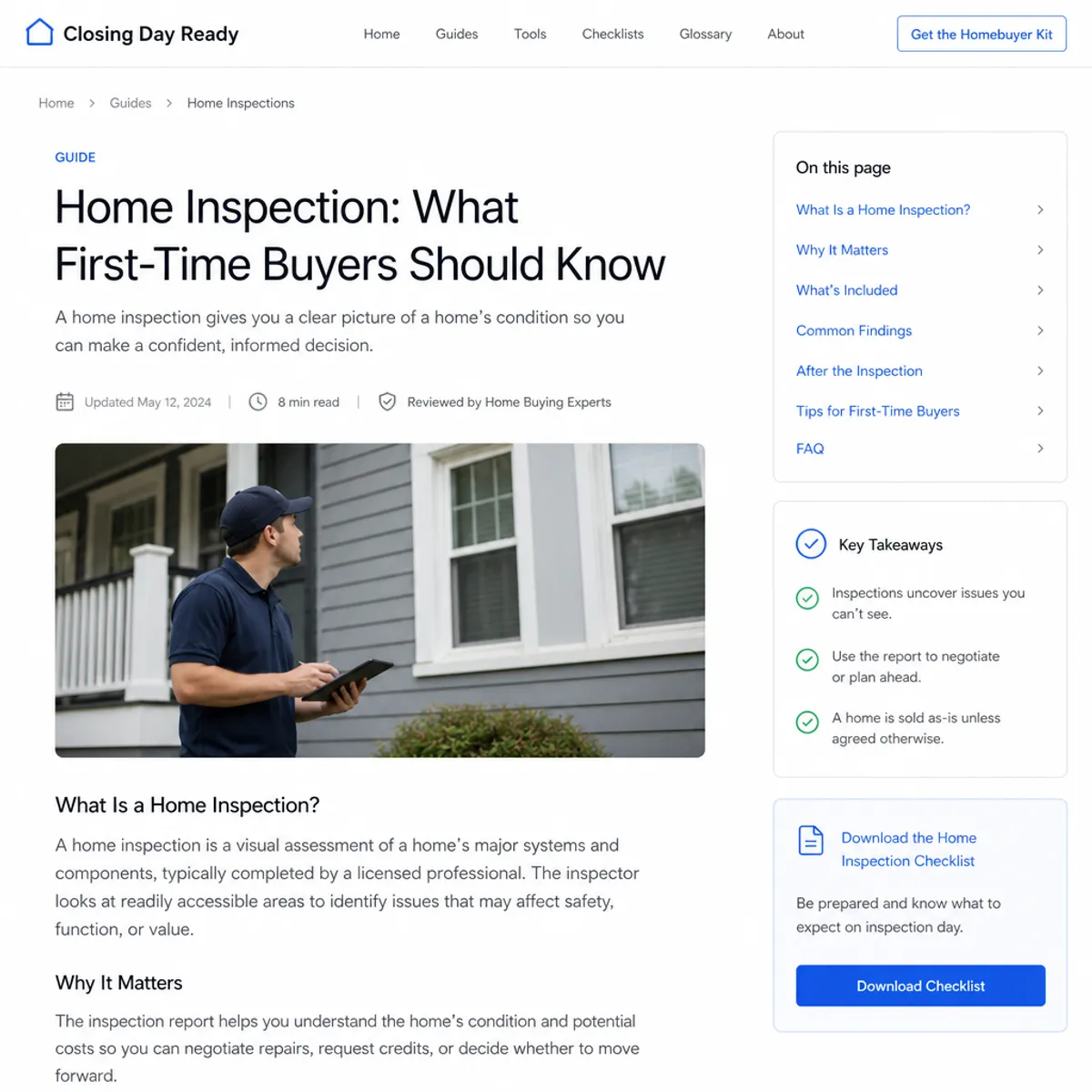
Home Inspection: Your Complete Guide from Hire to Close
Buying a home is one of the largest financial decisions most people will ever make, and the home inspection is the moment in that process where an objective professional gets to tell you exactly what you’re about to commit to. It sits at the center of the transaction — after the excitement of an accepted offer, before the finality of closing — and how you handle it will shape not just what you pay, but what you’re walking into when you turn the key for the first time. This guide walks you through every stage: what a home inspection is and what it covers, how to find and vet a qualified inspector, what happens on inspection day, how to read and act on the report, what the inspection contingency actually does for you legally, how to handle new construction, and how to make the decisions that bring you confidently to closing day.
What a Home Inspection Actually Is
A home inspection is a non-invasive, visual assessment of a residential property’s physical condition, conducted by a licensed professional before purchase. The inspector examines the home systematically — working through the structure, exterior, roof, attic, insulation, interior spaces, plumbing, electrical, and HVAC systems — and documents their findings in a written report that becomes one of the most important documents in your transaction.
The word “non-invasive” matters: the inspector is not tearing open walls, pulling up flooring, or operating equipment under conditions outside normal use. They are observing what is accessible and visible, which is why the inspection is technically a visual assessment rather than an engineering study or a guarantee. That said, an experienced inspector with good methodology and modern tools will catch a remarkable amount — including moisture intrusion behind drywall, failing electrical components, early-stage roof deterioration, and HVAC systems running outside normal parameters.
What makes the inspection so valuable is not that it catches every possible defect. It’s that it surfaces unknown risks before you’re legally obligated to own them. Data shows that 86% of inspections reveal issues that need repair, and buyers save an average of $14,000 through inspection-informed negotiations — making it one of the clearest examples in the entire buying process of a few hundred dollars protecting tens of thousands.
Why This Step Is Non-Negotiable
The home inspection is one of the most powerful buyer protections in the entire transaction. It surfaces hidden defects, informs negotiation, and can save buyers thousands of dollars — or prevent them from purchasing a costly problem property altogether. It is the only point in the process where an independent expert, working solely for you, evaluates the home before you are committed to buying it.
Though a home inspection can technically be waived, skipping it could be a mistake that leaves you on the hook for thousands of dollars in repairs you didn’t know needed to be made. During the competitive peak years of the early 2020s, waiving inspections became common as buyers raced to win multiple-offer situations. That tradeoff proved costly for many buyers who discovered problems only after closing — at which point they had no legal recourse tied to the inspection, no negotiating leverage, and no one to help them absorb the cost. As competition among buyers cools compared to those peak years, fewer buyers are willing to waive inspections, making inspection a standard — and expected — part of the transaction again.
The inspection is also a learning moment. Walking a home with an inspector for two to three hours teaches you more about its systems, maintenance needs, and quirks than any showing ever will. Even a report that comes back mostly clean is valuable: you leave inspection day with a mental map of what to watch, what to budget for, and how to maintain the property as a new owner.
How to Find and Vet a Qualified Inspector
Not all inspectors are equal, and choosing the right one is just as important as having the inspection itself. Buyers should always hire their own inspector independently — even if the seller offers a pre-listing inspection report — to ensure objectivity and to maintain the right to vet credentials, methodology, and sample reports personally.
Start with professional association membership. The two most recognized national associations are the American Society of Home Inspectors (ASHI) and the International Association of Certified Home Inspectors (InterNACHI). Both organizations maintain standards of practice, require demonstrated competency, and mandate ongoing continuing education. ASHI is celebrating 50 years in 2026 , a marker of longevity and professional consistency in the industry. Membership in either organization is a meaningful baseline signal, though it is a floor, not a ceiling — you still need to do your own vetting.
Beyond credentials, ask every candidate the same set of questions before hiring: How many inspections have you completed? Do you carry errors and omissions (E&O) insurance and general liability? Will you provide a sample report before I hire you? How long does a typical inspection take? Do you use thermal imaging, and is it included or billed separately? A well-prepared inspector will answer these questions confidently and without hesitation. An inspector who deflects or cannot produce a sample report is one to avoid.
Review the sample report carefully. A strong inspection report is not a checklist of “pass/fail” items — it is a narrative document with photographs, descriptions of conditions, severity ratings, and clear maintenance recommendations. If the sample report is vague, poorly organized, or lacks images, that is exactly what you will receive when it counts. Buyers and agents increasingly expect video walkthrough reports — narrated, timestamped documentation of every defect with visual evidence, so buyers see exactly what the inspector saw. That standard is worth looking for when evaluating candidates. The national average for a standard home inspection is around $343, with most buyers paying between $296 and $424.
A professional home inspection typically costs between $300 and $500, but the final price depends on your home’s size, age, and the inspector’s experience — a small condo might cost around $275 to inspect, while a large or older home with extra features like a pool or detached garage could push the price closer to $600 or more. Do not let price be the primary driver of your choice. The difference between the cheapest and most expensive inspector in your market is usually far smaller than the cost of a defect they might miss.
What a Standard Inspection Does — and Does Not — Cover
A general home inspection covers the major visible and accessible systems and components of a residential property. Roof covering and drainage. Structural components including the foundation, framing, and load-bearing walls. Attic and visible insulation. Interior rooms, ceilings, walls, floors, windows, and doors. Electrical service panel, branch circuits, and visible wiring. Plumbing supply and drain lines, water heater, and fixtures. Heating and cooling systems. Attached garages, decks, and other permanent structures. The inspector assesses these components for condition, apparent safety, and proper function — not code compliance or workmanship against current building standards.
What a standard inspection does not cover is just as important to understand. Radon gas, mold, wood-destroying pests and termites, sewer line condition, underground oil tanks, and specialized structural or foundation issues typically require separate add-on inspections. These are not oversights or shortcuts — they require different equipment, laboratory testing, or specialist credentials beyond general inspection scope. The final home inspection cost may increase further if you need specialized add-on inspections to look for mold, radon, termites, and more.
Whether to order these add-ons depends on the property, its age, its location, and what the general inspection reveals. An older home in a region with known radon risk warrants a radon test. A crawl-space home in a humid climate warrants a wood-destroying organism inspection. A home that the general inspector flags for possible sewer-line deterioration warrants a sewer scope. Think of the general inspection as the first layer of due diligence that identifies which specialist investigations you may also need — and build time and budget for those possibilities before inspection day arrives.
What to Do on Inspection Day
Attend the inspection in person whenever possible. This single decision will do more to make the written report useful to you than almost anything else. An inspector can show you a roofing issue or a panel concern in context, explain its severity in plain language, demonstrate a fixture that operates outside normal range, and answer your questions in real time — none of which translate perfectly to a photograph and a written description alone.
Arrive at the start of the inspection, not at the end. Many buyers show up for the last fifteen minutes to hear a verbal summary, missing the two to three hours where the real work happens. Bring a notebook or use your phone to take your own notes and photos alongside the inspector’s. Ask questions freely, but let the inspector work without interruption — walk with them, observe, and ask at natural transition points between areas.
Pay particular attention when the inspector lingers longer than expected on any area, asks to see utility records, or flags something for immediate follow-up. Those moments are signals. An inspector who spends five minutes in the attic and fifteen minutes in the electrical panel is telling you something without saying it explicitly. When you are physically present, you catch those signals. When you are reading a PDF three days later, you often do not.
A home inspection is more than just a pass/fail test for a house — it is your first in-depth introduction to your potential new home. The final report is incredibly valuable, but the process itself offers a unique learning opportunity. To really get your money’s worth, you should be an active participant. This means showing up, asking questions, and understanding how to interpret the findings. By engaging with the inspection process, you move from simply receiving a list of problems to gaining a comprehensive understanding of the property’s condition, its maintenance needs, and how its various systems work together.
How to Read the Report
The inspection report will arrive — usually within 24 hours of the inspection — as a detailed PDF or digital document that may run anywhere from 20 to 80 pages depending on the property and inspector’s methodology. A complete home inspection typically takes 2 to 4 hours, depending on the size and condition of the property, and most inspectors provide detailed reports within 24 hours of completing the physical inspection.
The most important skill in reading the report is triage. Not every finding carries equal weight, and a long report is not inherently a bad sign — older homes, in particular, will always generate more findings than newer ones simply because more has worn over time. Your job is to sort findings into three categories.
Deal-breakers are defects significant enough that they could affect your safety, make the property uninsurable, require immediate major expenditure, or fundamentally alter your assessment of what the home is worth. Examples include severe foundation failure, active structural movement, a roof that has reached the end of its serviceable life, outdated electrical systems that create fire or shock hazards, or high radon readings requiring mitigation. These are not automatically grounds to walk away — but they are grounds to get specialist estimates before you make any decision.
Negotiating points are real, quantifiable issues that a reasonable seller should address or compensate for, but that do not threaten the viability of the transaction. A water heater that is 12 years old and showing early signs of corrosion. A roof with two to three years of life remaining. A deck that needs railing repairs. These items represent legitimate grounds for requesting a repair credit, price adjustment, or seller-completed repair prior to closing.
Maintenance items are the normal wear, deferred upkeep, and minor cosmetic issues that come with any lived-in property. A door that needs weatherstripping. Minor caulking voids around a tub surround. A window that sticks slightly. These are informative — you now know to address them after you move in — but they are not negotiating points and should not be presented as such.
The report is a tool, not a verdict. A home that generates a 60-page report with dozens of maintenance items but no structural or major system concerns is often a better buy than a sparse 25-page report from a less thorough inspector. Read every finding, but weight them appropriately.
The Inspection Contingency: Your Legal Protection
The inspection contingency is the clause in your purchase agreement that transforms the inspection report from interesting information into actionable legal protection. It is one of the most important protections a buyer has in a real estate contract, yet many first-time buyers sign offers without fully understanding it. In plain terms, this clause gives the buyer the right to have the property professionally inspected within a set window and to act on what the inspection reveals — whether that means negotiating repairs, requesting a price reduction, or walking away with their earnest money intact.
Earnest money is the deposit a buyer puts down to show a seller they are serious, typically held in escrow and applied toward the purchase at closing. Without contingencies, a buyer who backs out risks forfeiting that deposit. The inspection contingency is one of the conditions that lets a buyer recover their earnest money if they cancel for a covered reason — in this case, inspection findings they are unwilling to accept — within the contingency window. That protection is the financial heart of the clause.
Within a defined window after the offer is accepted, the buyer hires an inspector, reviews the findings, and decides whether to proceed, request repairs or credits, or cancel the contract. If the buyer cancels within the contingency period for inspection reasons, they typically recover their earnest money deposit.
Common responses include asking the seller to make specific repairs before closing, requesting a credit toward closing costs so the buyer can handle repairs themselves, or negotiating a price reduction to reflect the cost of needed work. Some buyers accept the home as-is when findings are minor. The strongest negotiating positions focus on significant defects, safety hazards, and items the buyer could not have anticipated — rather than cosmetic or minor wear. Sellers are generally more receptive to addressing a failing roof or an unsafe panel than a list of trivial items. A balanced, prioritized request tends to keep the deal alive while still protecting the buyer.
Know your timeline precisely. Contingency windows typically run between five and fifteen business days depending on your contract and local practice, and missing the deadline — even by a day — can mean losing your right to exit with your earnest money intact. Set calendar reminders at the moment you go under contract.
When to Walk Away
Walking away from a deal after inspection is not a failure. It is the contingency working exactly as intended. The harder question is knowing when the findings actually justify it, versus when fear of a long report is driving an emotional response.
The clearest cases for walking away involve defects that cannot be economically remedied within the deal structure. If a foundation engineer’s follow-up report identifies movement requiring $40,000–$80,000 in stabilization work and the seller will not adjust price or provide credits that make the purchase viable, walking away is rational financial decision-making. The same logic applies when environmental hazards — significant mold colonies, a failing oil tank, contaminated soil — would require remediation exceeding what either party can practically solve before closing, or when the scope of needed work makes the property functionally uninsurable.
Walking away also makes sense when the seller’s response to legitimate repair requests is unreasonable or dismissive. A seller who refuses to acknowledge material defects, provides no credit or repair commitment on a failing roof, or counters with nominal offers on significant safety issues is signaling something about how the rest of the transaction — and post-close disputes — will go. You are not just buying a house; you are completing a negotiation with a counterparty, and how they behave when pressed matters.
The inspection contingency exists precisely so this decision never costs you your earnest money deposit. So long as you notify the seller of your intent prior to the deadline and by the method specified in the contract, you should get your earnest money back in full. Use that protection deliberately, not impulsively — but use it when the findings justify it.
New Construction Is Not an Exception
One of the most expensive myths in home buying is that new construction homes do not need inspections. They do — often more urgently than resale properties, because construction defects have a way of being hidden beneath new finishes, and because no one has yet had the chance to discover and report problems through normal use.
New construction inspections work differently from resale inspections. The most thorough approach involves phase inspections during the build itself: a pre-pour foundation inspection before the concrete slab is placed, a pre-drywall framing inspection while electrical, plumbing, and HVAC rough-ins are still visible, and a final inspection before closing. Each phase catches defects that would be invisible — and expensive — after the work is covered.
Even buyers who do not commission phase inspections should hire an independent inspector for the final walkthrough before closing — entirely separate from the builder’s own quality control process. The builder’s representative is not working for you. A third-party inspection of a finished new-construction home regularly surfaces punch-list items, installation errors, missing insulation, HVAC calibration issues, and grading problems that would otherwise go unaddressed once you’ve closed. New construction is booming across many markets, and so is a growing service: 11-month warranty inspections, which occur just before the builder’s one-year warranty expires, allowing homeowners to formally document defects before their contractual remedy window closes. Whether you order a pre-close inspection, an 11-month inspection, or both, the principle is the same: new does not mean defect-free, and your protection depends on independent verification.
From Report to Closing: Making the Inspection Work for You
The inspection report arrives at what is often the most consequential decision point of the entire transaction. You now know more about the property than you did when you made your offer. You have independent, documented information about its condition. And you have a defined legal window in which to act on that information.
Use it strategically. Prioritize your repair requests around the findings that matter most — the items that affect structural integrity, safety, insurability, or the home’s major systems. Present your requests clearly, backed by the inspector’s findings and, where appropriate, by contractor estimates. Be willing to accept credits or price reductions in lieu of seller-completed repairs when that gives you more control over the outcome. And move through the process without unnecessary delay: every day you spend negotiating is a day your contingency clock is running.
The buyers who come out of inspection best are not the ones who submit the longest repair lists or the ones who accept everything without question. They are the ones who understand what the report is actually saying, know which findings are worth pressing on, and negotiate from a position of information rather than emotion.
That said, navigating a report with significant findings is genuinely difficult — especially for first-time buyers who may be reading an inspection report for the first time and trying to assess contractor estimates, weigh negotiation strategies, and make major decisions on a tight timeline. When the stakes are high and the findings are complex, having a trusted, knowledgeable guide review your situation alongside you can make a significant difference — not just in what you negotiate, but in how clearly you understand every step between the report and the closing table. That’s the kind of support Closing Day Ready is built to provide: clear, unbiased, practical guidance at exactly the moment when buyers most need it.
Where Things Stand
The home inspection landscape in summer 2026 reflects a market that has decisively shifted away from the waiver culture of the pandemic-era frenzy — and fresh NAR data now puts a hard number on that shift. According to the NAR Realtors Confidence Index released June 9, only 17 percent of buyers waived the home inspection contingency on their winning offer in May 2026, down from 25 percent a year earlier, as inventory settles around 4.6 months of supply nationally. That said, the market is not uniformly buoyant: NAR’s August 11 existing-home sales report showed a 1.7 percent month-over-month decline in July, and the average 30-year fixed mortgage rate climbed to 6.54 percent in July per Freddie Mac — above the sub-6.4 percent range seen earlier in the year — pressuring first-time buyers in particular. The home inspection sector itself continues to draw new regulatory attention: the 12-state gap in licensing requirements persists, while Connecticut signed mold remediation reform into law in June 2026, requiring contractor IICRC certification effective October 1. On the technology side, thermal imaging and video walkthrough reports are becoming baseline expectations rather than premium add-ons, with lenders increasingly recognizing their value for reducing post-closing defect claims.
See Related Reads below for more on this topic.
For further reading, see the Sources listed below.
Related
Sources / Further reading
- Home Inspection Waivers Have Crashed To 17% — Inspection Professionals
- NAR Existing-Home Sales Report Shows 1.7% Decrease in July (August 11, 2026)
- NAR Pending Home Sales Report Shows 2.3% Decrease in July (August 18, 2026)
- Connecticut Signs Mold Remediation Reform Into Law — Cleanfax (June 3, 2026)
- Home Inspection Trends Reshaping the 2026 Housing Market — HousingWire (April 20, 2026)
Frequently asked questions
Do I really need a home inspection if the home looks to be in good shape?
Yes. Many of the most costly defects — deteriorating roof decking, aging electrical panels, early-stage foundation movement, plumbing leaks inside walls — are invisible to the naked eye during a showing. A general visual inspection takes two to four hours and typically costs $300–$500, a small price compared to the tens of thousands a hidden problem can cost after closing. A home that looks well-maintained can still have serious underlying issues that only a trained inspector with the right tools will catch.
What is the difference between a home inspection and a home appraisal?
An appraisal is ordered by the lender to determine the market value of the property, protecting the lender's collateral. A home inspection is ordered by the buyer to assess the physical condition of the property, protecting the buyer's interests. The two are separate processes performed by different professionals. An appraiser is not evaluating whether the furnace is near the end of its service life or whether the attic has adequate ventilation — that's the inspector's job. Buyers need both, and they serve entirely different purposes.
Can I use the inspection report to negotiate after I've already removed the inspection contingency?
Generally, no. Once you waive or release the inspection contingency, you've given up the contractual right to exit the deal or formally renegotiate based on inspection findings. You can still ask the seller informally, but the seller has little incentive to agree since you've already committed. This is why understanding your contingency timeline and not releasing it prematurely is so important. Never remove the contingency before you've reviewed the full report and are genuinely satisfied with what it contains.
What kinds of issues are considered deal-breakers versus negotiating points?
Deal-breakers typically involve significant structural defects (major foundation failure, severe roof deterioration), safety hazards (active knob-and-tube wiring, high radon levels, significant evidence of mold), or problems whose repair cost approaches or exceeds your financial limits. Negotiating points are issues that are real but quantifiable — a water heater near the end of its life, a roof with a few years left, minor plumbing repairs. Cosmetic issues like scuffed trim or dated fixtures are generally not worth pressing on at all. The goal is to use the report strategically: pursue the significant items, set aside the minor ones, and keep the deal moving toward closing.