Home Inspection Report: Read It and Know What to Negotiate
Published on · Updated on
Home Inspection · home buying · home inspection · negotiation · home inspection report · inspection contingency
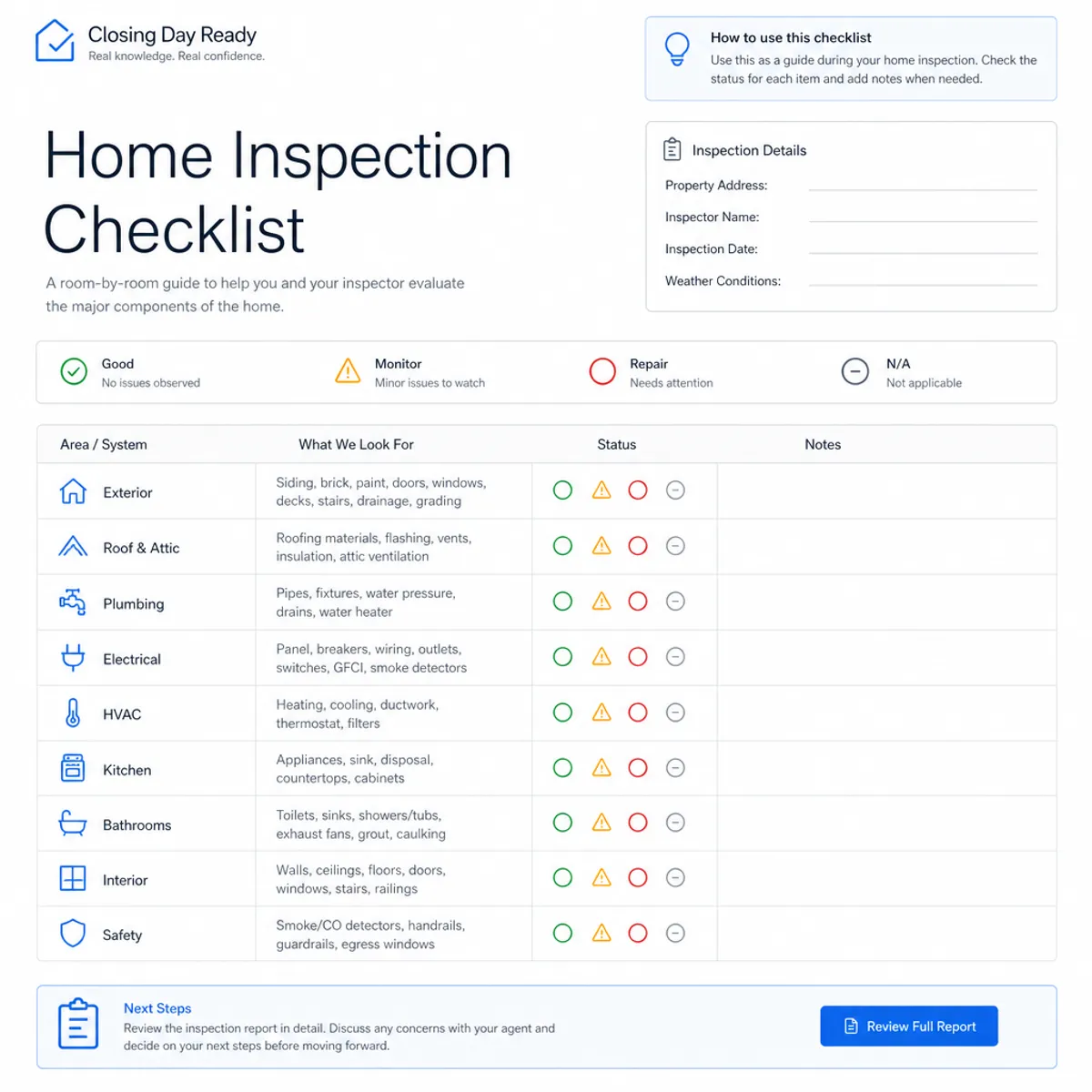
Home Inspection Report: Read It and Know What to Negotiate
You’ve made an offer, it’s been accepted, and now — sometimes within 24 hours — a PDF lands in your inbox. It might be 40 pages long. It might contain hundreds of line items with color-coded labels, small photographs, and abbreviations you’ve never seen before. This is your home inspection report, and how you read it in the next few days will directly shape your negotiation, your closing costs, and your confidence walking into the home you’re about to buy.
The good news: most buyers overcomplicate this moment. With the right framework, a thorough inspection report is not a reason to panic — it’s the most powerful information advantage you’ll have in the entire transaction.
Start Here: Understand the Severity Rating System
Before you read a single finding, flip to the front of the report and find the legend. Modern inspection reports are built around a severity rating system, and every conclusion you draw about the property depends on understanding what those labels actually mean. Most professional inspectors use some version of four categories:
- Safety — a condition that poses an immediate or near-term risk of injury
- Major Defect — a significant system failure or structural issue likely to require expensive repair
- Repair/Maintain — a functional item that needs service, adjustment, or replacement in the near term
- Monitor — a condition that isn’t urgent but should be watched after move-in
These labels go by slightly different names across different report formats, but the logic is consistent: they exist to help you prioritize, not to list every imperfection as a crisis. A report that flags 80 items sounds alarming until you notice that 65 of them are “Monitor” or “Repair/Maintain” items — a leaky garden hose bib, a missing GFCI outlet in the garage, paint peeling on a window sill. Reading the severity codes first resets your entire perspective on the document.
One practical tip: scan the report once at full speed, skimming only the headings and severity labels. Don’t read the descriptions yet. This first pass gives you a rough map — how many Safety flags, how many Major Defects — before you go deep into any individual finding. If that triage reveals three or four red-flag items, you’re likely dealing with a normal older home. If it reveals twelve Safety issues and six Major Defects, you’re looking at something genuinely serious.
Triage Your Findings Into Three Buckets
Once you understand the rating system, your job is to sort every finding into one of three buckets: items to request the seller remedy, items to accept and budget for, and items to monitor after move-in. Nearly every report contains all three, and very few items in any category are true deal-breakers.
Bucket 1: Request the Seller Remedy
These are findings where the cost, the risk, or the ambiguity is significant enough that you shouldn’t absorb them without negotiation. Prioritize:
- Any item rated Safety or Major Defect, particularly involving the electrical panel, roof structure, foundation, or HVAC
- Active water intrusion or evidence of mold
- Items that affect habitability or lender approval — for FHA and VA loans especially, certain defects must be remedied before the loan can fund
- Anything the standard inspector couldn’t fully evaluate and flagged for specialist follow-up
This last point is critical. When your inspector writes a note like “recommend evaluation by a licensed electrician” or “HVAC system is at end of expected service life — obtain HVAC contractor assessment,” that’s not a throwaway comment. It’s a signal that the potential cost range is wider than a general inspector can quantify. Before you submit your repair request, get that specialist quote. Real cost data — not a guess — is what anchors a negotiation.
Bucket 2: Accept and Budget For
These are items that are real, but reasonable to own. Examples include an aging but still-functional water heater, minor weatherstripping gaps, older but code-compliant electrical fixtures, or a roof with several years of useful life remaining. Most buyers purchasing a home that is more than ten years old will have a full bucket here. The answer isn’t to demand the seller fix everything; it’s to factor these into your first-year ownership budget.
Bucket 3: Monitor After Move-In
Some findings are genuinely low urgency — a small hairline crack in drywall at a door corner, staining on a ceiling with no evidence of active moisture, normal settling of an older home. These belong in your notes, not your repair request. Getting deliberate about this triage separates buyers who negotiate effectively from those who either demand too much (and trigger seller pushback) or too little (and leave money on the table).
Build a Focused Repair Request — Not a Laundry List
Here’s where many buyers make their first and most costly mistake: they send the seller a request that mirrors every single item in the report. It feels thorough. It’s actually counterproductive.
A focused repair request covering three to five high-impact items is more effective than a line-by-line demand. Agents and inspectors consistently advise the same thing: prioritize safety issues and major system failures, leave cosmetic defects out of the formal request, and present your asks with documentation.
What does strong documentation look like? Reference the specific page or finding number in the report. Attach the specialist quote where you have one. Where a quote isn’t yet available, describe the finding in plain language and request either remediation by a licensed contractor prior to closing or a seller credit in lieu of repairs. A seller credit gives you control over the quality of the work; a repair done by the seller’s vendor gives you less.
One useful structural rule: group your requests thematically rather than numerically. “Buyer requests remediation of or credit for (1) the exposed wiring at the main panel identified on page 12, (2) the active roof leak over the master bedroom identified on page 7, and (3) the non-functional furnace heat exchanger identified on page 22” reads as reasonable, specific, and professional. A 22-item list reads as a stress response.
Keep your tone neutral and factual. The inspection report isn’t a grievance — it’s a record of the property’s condition on a specific day. Framing your request around that record, rather than disappointment, keeps the conversation productive.
Know Your Deadline — And Don’t Miss It
The inspection contingency is not just a procedural formality. It is a hard calendar constraint, and missing it has real consequences.
In most purchase agreements, the inspection contingency window runs somewhere between five and ten days after acceptance. Within that window, you have the right to review the report, request repairs or credits, and — if the seller refuses and the issues are material — exit the contract and recover your earnest money. Once the window closes without action, the contingency is typically waived. You remain in contract, and your negotiating leverage on inspection findings largely disappears.
Mark the deadline the moment your offer is accepted. Build your timeline backwards from it: allow one to two days for the inspection itself, one day to receive and read the report, one to two days for any specialist follow-ups you need, and at least one day to draft your request with your agent. In a typical seven-day window, that leaves almost no slack. If your inspector is booked out or a specialist takes longer to respond, the pressure compounds quickly.
Your agent should be tracking this deadline alongside you, but don’t assume someone else has it handled. Pull up your purchase agreement, find the contingency expiration date and time, and add a calendar reminder for the day before.
When to Walk Away — and When That’s the Wrong Call
Not every problematic inspection report justifies walking away. In fact, most don’t. Buyers who exit contracts over cosmetic findings, minor maintenance items, or the normal wear of a lived-in home often do so out of report-induced anxiety rather than genuine financial risk.
True deal-breakers tend to be structural. A foundation with active movement rather than historical settling. A roof that requires full replacement and the seller won’t negotiate. Significant undisclosed water damage with mold that requires remediation. An electrical system so outdated that insurance underwriters will flag it. In these cases, the math changes: if repair costs are high, the seller is unwilling to negotiate, and the purchase price doesn’t reflect the condition, exiting is a rational decision.
But the bar for “deal-breaker” should be set by actual cost and risk, not by the length of the report. A 60-item inspection report on a well-maintained 1970s ranch house may be far less concerning than a 15-item report on a flipped property where someone painted over the problems.
If you’re genuinely uncertain about whether a finding is serious, your inspector is your first call — not real estate forums, not social media comments from strangers who haven’t seen the property. Ask the inspector directly: If this were your house, what would you do? That question tends to produce more useful answers than any other.
After the Negotiation: Closing the Loop
Once the seller responds to your repair request — whether with agreement, a counteroffer, or a credit — confirm everything in writing through the formal addendum process. Do not accept verbal assurances that something will be fixed before closing.
If the seller agrees to make repairs, schedule a final walkthrough before closing to verify completion. Bring the relevant pages of the inspection report and confirm that each item was addressed to a reasonable standard. If the seller agreed to a credit instead, verify that the credit appears correctly on the closing disclosure before you arrive at the closing table.
Your agent handles much of this coordination, but staying organized pays off. Keep a single document — even a simple notes file — that tracks each requested item, the seller’s response, and the verification status. That documentation matters if a dispute arises at or after closing.
A clean inspection outcome — whether that’s a credit, completed repairs, or a clear decision to accept the condition as-is — is one of the last major milestones before closing. Once it’s behind you, the transaction moves quickly. That’s exactly the moment to confirm that your mortgage pre-approval still reflects current conditions, particularly if a credit shifted the purchase price or your rate lock is approaching its expiration. Our financing guides at Closing Day Ready walk you through what to revisit with your lender in the final weeks before you reach the closing table.
Where Things Stand
The 2026 housing market has firmly restored the inspection contingency as a standard buyer protection — and the latest data shows that trend accelerating. NAR’s Realtors Confidence Index for May 2026 recorded only 17% of buyers waiving the inspection contingency on winning offers, down sharply from 25% a year earlier, as inventory climbed to 4.5 months of supply nationally and bidding wars eased. Post-inspection negotiating leverage has only grown: Redfin data shows seller concessions appeared in 46.2% of home sales through May 2026 — a record high for the spring period and up from 43.1% a year prior — with buyers routinely requesting repair credits, closing-cost coverage, and rate buydowns. On the technology side, thermal imaging is now becoming baseline rather than a premium add-on, with inspectors using infrared tools to surface hidden moisture, insulation gaps, and electrical hotspots that sharpen post-inspection negotiation. The broader market context has grown more complex: mortgage rates have drifted higher than earlier forecasts anticipated, with the 30-year fixed averaging 6.65% as of August 20, 2026 — above the 6.25% referenced earlier this year — as geopolitical pressures keep upward pressure on rates and buyers adapt to a higher-for-longer environment.
See Related Reads below for more on this topic.
For further reading, see the Sources listed below.
Related
Sources / Further reading
- U.S. Housing Increasingly Becoming a Buyer's Market in 2026: Redfin — Scotsman Guide
- What Are Seller Concessions, and How Do You Use Them? — Yahoo Finance
- Home Inspection Trends Reshaping the 2026 Housing Market — HousingWire
- Freddie Mac Primary Mortgage Market Survey — August 20, 2026
- August 2026 Real Estate Market Update — Churchill Mortgage
Frequently asked questions
What should I do if I don't understand the severity codes in my inspection report?
Call your inspector before you do anything else. Most inspectors are happy to do a brief phone walkthrough of the report, and many include a legend on the first page explaining their rating system. Your buyer's agent can also help you interpret findings in the context of local norms — what counts as a 'major defect' in a 1960s ranch house differs from the same label on a new build.
Can I ask for repairs on every item listed in the inspection report?
Technically yes, but strategically no. A request covering every finding — including minor cosmetic items — signals inexperience to the seller and often triggers a defensive response. Focus your formal repair request on safety issues, major system failures, and items backed by specialist quotes. Save cosmetic items for post-closing budgeting.
What happens if the inspection contingency deadline passes before I submit a repair request?
If you miss the contingency window without acting, you typically waive your right to negotiate based on inspection findings and lose your ability to exit the contract without forfeiting your earnest money. Mark the deadline on your calendar the moment your offer is accepted, and confirm the exact expiration date and time in your purchase agreement.
Is a seller credit better than asking the seller to make the repairs themselves?
It depends on the item and the seller. A seller credit gives you control over who does the work and to what standard — important for electrical or structural repairs. However, if the lender requires certain repairs to be completed before funding (common for FHA and VA loans), a seller credit alone may not satisfy underwriting. Ask your lender before choosing between the two options.