How Long Does a Mortgage Pre-Approval Last? A Full Guide
Published on · Updated on
Mortgage Pre-Approval · Mortgage Pre-Approval · Home Buying · First-Time Homebuyers · how long does a mortgage pre-approval last · Mortgage Process
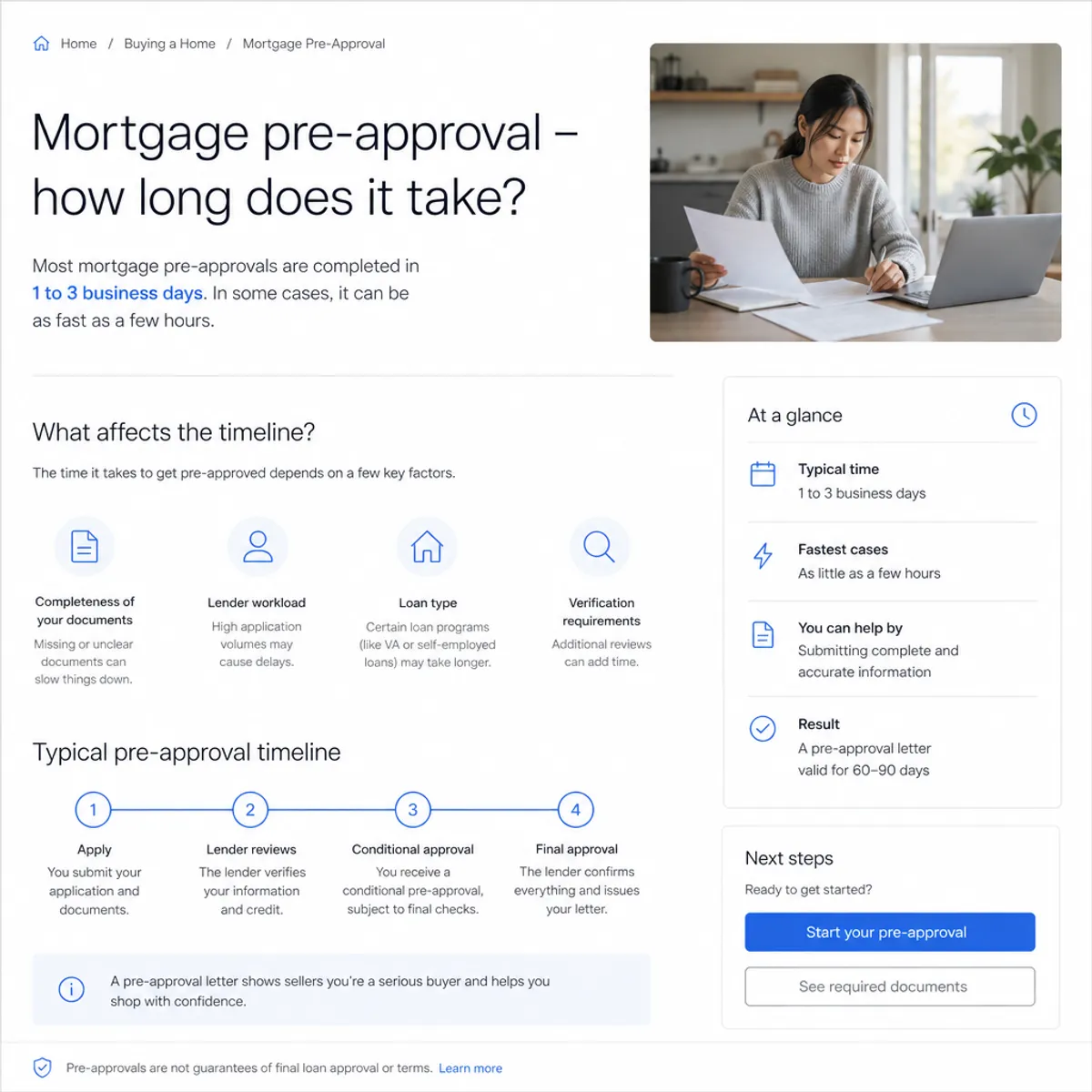
What a Pre-Approval Letter Actually Represents
Before you can meaningfully answer how long a pre-approval lasts, it helps to understand what the letter actually is. A mortgage pre-approval is a lender’s way of saying you’re financially qualified to borrow a certain amount to buy a home, based on a review of your credit history, income, assets, and debts. Crucially, it is not a guarantee. Pre-approval is not a final loan approval — a lender must still approve a mortgage loan at specific terms when you’re ready to purchase a home.
What makes the letter valuable is exactly what makes it perishable: it is built on a verified snapshot of your finances taken at a specific moment in time. A pre-approval rests on three pieces of information that all have their own shelf lives — your credit report, your income documents such as pay stubs, W-2s, and tax returns, and your asset statements — each of which is governed by agency verification rules that cap how old the underlying data can be at closing. Because those inputs have expiration dates baked into them by Fannie Mae, Freddie Mac, FHA, VA, and USDA guidelines, the letter sitting in your inbox does too.
The Standard Validity Window: 60 to 90 Days
In most cases, mortgage pre-approvals are valid for 60 to 90 days, though the specifics can vary depending on the lender, loan type, and individual financial circumstances. That range isn’t arbitrary. Most lenders issue pre-approval letters valid for 60, 90, or 120 days from the issue date, and 90 days is the most common standard across the industry because it aligns with the 120-day credit-report shelf life and leaves room for offer, contract, and closing inside the same verification cycle.
The math explains the policy. Fannie Mae’s Selling Guide is specific: credit documents — the credit report plus employment, income, and asset documentation — may be no more than four months old on the note date, the day you sign the final loan paperwork.
If you go under contract on day 89 of your pre-approval and closing takes another 30 to 45 days, your original documents would age past the four-month limit before the note date — so the shorter letter window leaves room for the escrow period, meaning the file that earned you the letter can still carry you through closing. A lender who offers a 90-day letter is not being stingy; they are engineering the timeline so the underlying documents remain valid all the way to your signature.
Some lenders set tighter windows. Bank of America, for example, issues pre-approvals valid for 60 days, which in a competitive market ensures buyers respond promptly. Others lean toward the outer edge: some credit unions extend pre-approvals to 120 days.
Some lenders may shorten or lengthen this window based on market volatility or internal policies. The single most reliable way to know where you stand is to read the expiration date printed on your own letter. The exact expiration date should be printed on the letter, usually in the footer or fine print — and if the date is not listed, call your loan officer to confirm the lender’s policy.
Why Pre-Approvals Have an Expiration Date at All
The expiration exists because a pre-approval is a conditional commitment, not a contract. Lenders can’t commit to pre-approving a mortgage for any borrower indefinitely because personal financial circumstances can change over time, and lenders need to base their pre-approval estimates on up-to-date information — reviewing the most recent time-sensitive documentation like pay stubs, bank statements, and credit scores.
Think about everything that can shift in 90 days. You could take on a new car loan, raising your debt-to-income ratio enough to change your approval amount. You could switch jobs — even for higher pay — creating an employment-gap question that underwriters want to see resolved. Your credit score could tick up or down due to new account activity or a missed payment. Changes in your credit score during the waiting period could impact your pre-approval loan terms and interest rate — a dip could mean higher mortgage rates, while an improved score could work to your advantage.
Interest rates add another dimension that many buyers underestimate. A pre-approval does not lock your rate — rate locks only happen once you have a property under contract — so if rates rise while you shop, the payment you qualify for changes with them. A letter issued when the 30-year fixed rate sat at one level may describe a meaningfully different monthly payment than the market offers 90 days later. This is one reason why lenders treat pre-approval letters as living documents rather than permanent records.
How Validity Varies by Loan Program
The four primary loan programs — conventional, FHA, VA, and USDA — each carry their own documentation requirements, and individual lenders layer their own policies on top of program guidelines.
Conventional Loans
Conventional loans are not guaranteed by the government, and pre-approval usually lasts 60 to 90 days. Fannie Mae and Freddie Mac both tie their document-age requirements to the note date, giving lenders flexibility in how they calibrate their letter validity windows within that boundary.
FHA Loans
FHA loans are guaranteed by the Federal Housing Administration, and pre-approval usually also lasts 60 to 90 days. Pre-approval validity periods for FHA loans are usually the same as regular loans at 90 days, but the documentation required for renewal can be more rigorous. FHA also governs appraisal validity independently: once full loan approval is official, the loan must close within 150 days — a 120-day validity period for the original report plus a 30-day extension — if the appraisal has not been updated.
VA Loans
VA loans are backed by the Department of Veterans Affairs, and pre-approval typically also lasts 60 to 90 days. Pre-approvals for VA loans are usually valid for up to 90 days, and they can be accommodating for veterans who may need extra time because of special circumstances. Some sources note that VA program rules themselves permit up to 120 days of document validity, but the lender’s internal policy is the binding constraint in practice.
USDA Loans
USDA loans are backed by the USDA and are used for buying homes in rural areas, with pre-approval also usually lasting 60 to 90 days. USDA loan pre-approval validity can run to 60 days depending on whether the borrower is in the guaranteed versus direct program. As with the other programs, the agency ceiling and the individual lender’s own policy may differ, and it is always worth confirming which clock governs your specific letter.
A Note on Lender Variation
None of these timelines are set in stone at the program level. These timelines are not set by law — each lender sets its own policy.
Each lender sets their own pre-approval expiration policy, so validity periods can range from 30 to 120 days depending on the lender. Program rules establish the outer boundary; the lender you choose determines where inside that boundary your letter lands.
Timing Your Application: The Goldilocks Problem
The validity window creates a real strategic tension for buyers. Pre-approval is typically valid for 60 to 90 days, so it’s best to wait to apply until you’re actively ready to start touring homes. Apply too early and the letter expires before you find the right property. Apply too late and you’re scrambling to get paperwork together while competing against buyers who already have their financing in order.
Apply too early and the pre-approval expires before you find a home; apply too late and you’re rushing to close. The practical sweet spot for most buyers is to begin the pre-approval process shortly before — ideally one to two weeks before — you intend to start serious house-hunting. That alignment gives you the full validity window to search while keeping your documentation fresh enough to carry through the offer and closing process.
Knowing your search timeline honestly is part of this calculus. Research by the National Association of Realtors shows that home buyers usually spend about ten weeks actively looking for a home before making a purchase — a timeframe that fits neatly inside a 90-day window but can push up against the edges if the search extends or negotiations stall. Buyers in highly competitive markets, or those searching across a wide geographic area, may find themselves at the outer limit faster than they anticipated.
What Happens When a Pre-Approval Expires
An expired pre-approval is not a disaster — but it is a gap that needs to be closed before you can make a serious offer. When your pre-approval expires, you’re essentially sidelined for a while — you won’t be able to make a serious offer until you renew it, which can create problems in competitive real estate markets where homes receive multiple offers in just days or even hours.
The renewal process itself is usually straightforward. If your mortgage pre-approval expires, you’ll need to renew it — and this is common and usually straightforward.
You’ll need to provide updated documentation — such as your most recent bank statements, pay stubs, or any changes to your financial situation — to ensure your pre-approval remains accurate and valid. A clean renewal is usually 24 to 72 hours when the file has not changed much.
However, the renewal is not just an administrative reset. Lenders will conduct a new credit check, reassessing your credit score and debt history — and if anything has changed, whether positively or negatively, it can affect how much you are approved to borrow or the terms of the loan. If your income decreased, your debt increased, or your credit score fell, you might qualify for less favorable terms than before, while improved finances could mean better loan conditions. There is also the rate environment to consider: watch out for interest rate changes when your pre-approval expires — the mortgage rate you received 90 days ago may not be the same when you reapply.
The smarter play, if you can manage it, is to renew proactively before the letter lapses rather than after. If you’re already touring homes or submitting offers, don’t wait until your letter lapses — renewing early ensures your pre-approval stays current, which helps avoid delays if you suddenly find the right home, and most lenders can refresh your documents without restarting the entire process.
How to Keep Your Pre-Approval Healthy During Your Search
Maintaining a valid pre-approval isn’t only about watching the calendar. The same financial behaviors that earned you the letter in the first place need to hold steady throughout your search. To keep your pre-approval active, try to keep your finances stable — avoid making big purchases on credit cards, applying for personal loans, or anything that could impact your debt-to-income ratio, since keeping your financial profile steady helps ensure your pre-approval is valid when you’re ready to make a serious home purchase.
A few specific habits matter most. First, avoid opening new credit accounts. Every new inquiry and new account line signals potential added debt to underwriters. Second, don’t make large deposits or withdrawals from the bank accounts your lender reviewed — unexplained cash movements trigger documentation questions that can slow the file. Third, stay in your current job if at all possible; employment changes require additional verification that can push timelines. During the renewal period, keeping income and debt levels the same can be helpful, which might mean avoiding new credit cards, taking out big loans, or moving large amounts of money between accounts.
It’s also worth staying in touch with your loan officer throughout your search — not just when you’re ready to make an offer. Updating your pre-approval letter before submitting an offer is a good practice , even if the formal expiration date is still weeks away. A freshly dated letter signals to sellers that your financing is current, not a document you’ve been carrying around since the beginning of your search.
When Renewal Becomes an Opportunity
Here is something most buyers don’t realize: renewing a pre-approval isn’t always a setback. In some cases it’s a genuinely useful checkpoint. A fresh pre-approval can unlock a higher purchase price, a better rate tier, or lower mortgage insurance than the original letter offered, and the renewal conversation is also the right time to revisit those numbers and decide whether locking your rate early in the next offer cycle makes sense.
If your credit score has improved since your original application — because you paid down a balance or an old negative item aged off your report — you may qualify for a better rate on renewal than you did the first time around. If you’ve continued saving, your debt-to-income ratio may have improved. And if you’ve been house-hunting long enough to refine your target price range, your loan officer can recalibrate the approval amount to match your actual search criteria rather than a rough estimate from weeks ago.
The renewal conversation is also a natural moment to revisit whether the loan program you originally applied for still makes the most sense. Market conditions, property type, and down payment size all evolve as a search progresses, and the loan product that looked right at the start may not be the optimal choice three months in.
Timing, Guidance, and Not Losing a Home to a Paperwork Gap
Understanding the 60-to-90-day window is the first piece of the puzzle, but knowing exactly when to act within that window — and what to do when it runs short — is where the difference between a smooth closing and a stressful one often gets made.
This is precisely where working with a knowledgeable mortgage advisor pays dividends. An advisor who knows your timeline can help you sequence the application so the letter stays current throughout your most active searching period. They can alert you well before the expiration date, initiate a renewal while your documents are still fresh, and help you navigate any financial changes that might affect your qualification in the interim. In a competitive housing market where sellers evaluate financing strength alongside offer price, a letter that’s current and clean is a genuine negotiating asset — and letting it lapse is a gap you simply don’t want to have when the right home appears.
The mechanics of pre-approval are straightforward once you understand them. The strategy of timing them correctly — and renewing them proactively rather than reactively — is the kind of guidance that keeps buyers competitive from their first offer letter all the way to the closing table.
Where Things Stand
The core rules governing mortgage pre-approval validity have not changed, but the market context has shifted meaningfully since early August. The 30-year fixed-rate mortgage peaked at 6.81% in the week ending July 31 — its highest level in a year — before easing to 6.65% as of August 20, 2026, according to Freddie Mac, as a weaker-than-expected July jobs report cooled expectations for an imminent Fed rate hike. That September meeting is no longer a clear hold: J.P. Morgan now expects a 25-basis-point hike, though Goldman Sachs calls one “very unlikely,” and CME FedWatch puts the odds near 30%. Demand remains soft: MBA data for the week ending August 14 showed mortgage applications down 0.4%, with purchase applications falling 2% week-over-week and 3% below last year’s pace. Redfin reported pending home sales dropped to their lowest level since March as of the week ending August 16 — confirming that a pre-approval issued even a few weeks ago may no longer accurately reflect current purchasing power or market conditions.
See Related Reads below for more on this topic.
For further reading, see the Sources listed below.
Related
Sources / Further reading
- Mortgage Applications Decrease in Latest MBA Weekly Survey (Week ending Aug. 14, 2026)
- Will the Fed Hike Rates in September? A 25-Basis-Point Move Is Now Expected – Chase/J.P. Morgan
- Odds of Fed Rate Hike This Year Fall as Goldman Sachs Warns Against Hawkish Bets – Yahoo Finance
- Redfin Reports New Listings Tick Up As Summer Winds Down (week ending Aug. 16, 2026)
- Why The Fed Will Raise Rates In September Despite Cooler CPI – Forbes
Frequently asked questions
Can a pre-approval expire while I'm already under contract?
Yes, it can — but it's usually a non-event. Once you're under contract, your lender continues building the loan file through underwriting and closing. If the credit report used for your pre-approval is nearing its 120-day limit, your loan officer will simply pull a refreshed report as part of the standard closing checklist. You typically won't need to resubmit a full application; just provide updated pay stubs and bank statements when your lender asks.
Does renewing a pre-approval always require a new hard credit pull?
Not always. If you request a renewal before your letter has fully expired and your financial situation hasn't materially changed, some lenders can extend or refresh the letter using the existing credit report, provided it's still within the 120-day window. Once the report ages out, a new hard inquiry is required. The credit score impact of a single hard pull is typically small — usually 0 to 5 points — and shopping multiple lenders within a 14- to 45-day window is generally counted as one inquiry by the major credit bureaus.
Does getting pre-approved with multiple lenders hurt my credit score?
Minimally, if you do it within a concentrated window. Credit scoring models recognize mortgage rate shopping and typically treat multiple mortgage inquiries made within 14 to 45 days as a single inquiry. The practical advice: if you want to compare offers from two or three lenders, submit those applications close together rather than spread across months.
Is a pre-approval the same as a final loan approval?
No. A pre-approval is a conditional commitment based on a snapshot of your finances at the time you applied. Final loan approval — also called clear to close — comes only after the lender has verified the specific property through an appraisal, completed full underwriting, and confirmed that nothing in your financial picture has changed since pre-approval. Keeping your finances stable between pre-approval and closing is critical to ensuring the conditional commitment becomes a real one.