Mortgage Pre-Approval: The Complete Guide for Homebuyers
Published on · Updated on
Mortgage Pre-Approval · mortgage · home financing · first-time homebuyers · mortgage pre-approval · home buying process
What Mortgage Pre-Approval Actually Is — and Why It Matters
Mortgage pre-approval is one of the most misunderstood terms in the home-buying process. Many buyers treat it as a formality, a checkbox to tick after they’ve fallen in love with a house. In reality, it is the financial foundation that every other step of the purchase is built on, and understanding it precisely — not just roughly — can mean the difference between winning and losing a home, and between a loan that closes smoothly and one that falls apart at the worst possible moment.
At its core, mortgage pre-approval is a lender’s conditional, documented commitment to lend you up to a specific dollar amount. The word “conditional” matters. The lender is telling you they have reviewed your verified financial information — your credit report, income documentation, tax returns, employment history, and assets — and that, assuming nothing material changes, they are prepared to fund a mortgage in that range. It is not a guarantee of final loan approval, but it is far more substantive than its weaker sibling, prequalification.
Prequalification is typically based on information you self-report in a brief conversation or online form, and most of the time it involves only a soft credit check. Prequalification can give you a rough sense of what you might qualify for, but it does not tell a seller anything meaningful about your ability to close. Pre-approval, by contrast, requires verified documentation and a hard credit pull. That distinction is what gives a pre-approval letter real weight in a competitive market — the lender has done the work, not just taken your word for it.
What Lenders Are Actually Evaluating: The Four Pillars
Understanding what lenders scrutinize during pre-approval allows you to prepare strategically rather than scrambling reactively. There are four core pillars, and weakness in any one of them can slow the process, shrink your approval amount, or result in a denial.
1. Credit Score and Credit History
Your credit score is the first number lenders look at, and it does more than determine whether you qualify — it determines the interest rate you’ll be offered. Conventional loan programs typically require a minimum score of 620, while FHA loans can go lower, and jumbo products often require 700 or higher. But the range within “qualifying” scores is vast: a score of 760 will earn you meaningfully better terms than a score of 640 on the same loan amount, often by a quarter of a percentage point or more, which compounds significantly over a 30-year term.
Beyond the score itself, lenders examine the history behind it: how long you’ve had credit, whether you’ve made payments on time, how much of your available revolving credit you’re using, and whether there are any recent derogatory marks like collections, late payments, or public records. If your score needs work, improving it before applying is almost always worth the time — even a modest improvement can change your rate tier and save thousands in interest.
2. Debt-to-Income Ratio (DTI)
Your debt-to-income ratio measures how much of your gross monthly income is already committed to debt payments. Lenders calculate two versions: the front-end ratio (your projected housing payment as a percentage of income) and the back-end ratio (all monthly debt obligations combined, including the new housing payment). Most conventional loan programs want to see a back-end DTI at or below 43–45%, though some loan programs allow higher with compensating factors, and others require lower.
DTI is the pillar that surprises buyers most often, particularly buyers with solid incomes but significant student loan balances, car payments, or other recurring obligations. If your DTI is too high, the path forward is usually reducing existing debt before applying, avoiding new debt during the house-hunting period, or looking at a lower purchase price. It’s also worth noting that some lenders are more flexible on DTI calculations than others, which is one of the reasons shopping multiple lenders matters.
3. Employment and Income Stability
Lenders want to see a stable and verifiable income history. For salaried W-2 employees, that typically means two years of consistent employment, ideally with the same employer or in the same field. For self-employed borrowers, lenders generally look at two years of tax returns and calculate income based on adjusted gross figures — which can be substantially lower than gross revenue, catching self-employed buyers off guard.
Recent job changes aren’t automatically disqualifying, particularly if you stayed in the same profession or moved to a higher-paying role. But changing industries or moving from salaried to self-employed employment close to a purchase can create significant complications. Contract workers, freelancers, and people with variable income can absolutely qualify for mortgages — it just takes more documentation and, in some cases, a lender with more experience underwriting non-traditional income profiles.
4. Assets: Down Payment and Reserves
Lenders verify that you have the funds for your down payment and closing costs, and they also want to see reserves — money left over after closing that could cover several months of mortgage payments if your income were disrupted. The specific reserve requirements vary by loan type and lender, but having assets beyond exactly what you need to close generally strengthens your application.
One area that consistently creates delays: the sourcing of funds. Lenders don’t just want to confirm you have money — they need to verify where it came from. Large recent deposits that can’t be explained by regular income, transfers from undisclosed accounts, or cash that hasn’t been seasoned in your account for at least 60 days can all trigger additional documentation requests. If you’re receiving a cash gift from a family member for your down payment, most loan programs allow this, but it requires a signed gift letter and a paper trail showing the transfer.
The Documents You Need to Get Pre-Approved
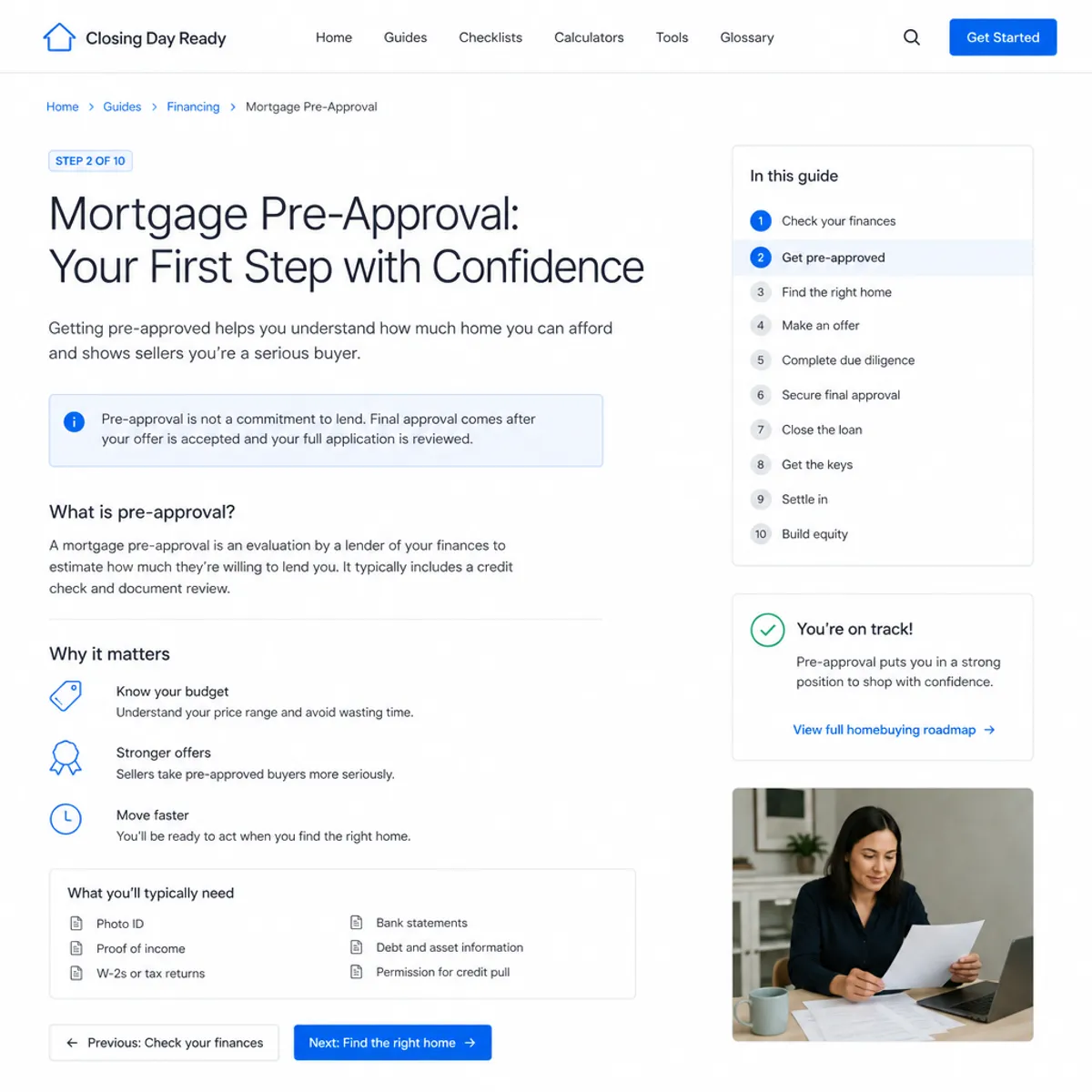
One of the most actionable things a buyer can do before beginning the pre-approval process is to gather their documents in advance. Back-and-forth between buyers and lenders over missing paperwork is one of the leading causes of pre-approval delays. Most lenders will ask for:
- W-2s from the past two years
- Federal tax returns (personal, and business returns if self-employed) from the past two years
- Recent pay stubs covering the past 30 days
- Bank and investment account statements for the past 60 days (all pages, including ones that appear blank)
- Government-issued photo ID
- Social Security number (for the credit pull)
- Documentation of any other income sources — rental income, alimony, child support, retirement distributions, or investment income
- Information on existing debts — loan statements, lease agreements, and account numbers
If you have additional complexity — a business, foreign assets, income from multiple sources, or a recent financial event like a bankruptcy or short sale — additional documentation will be required. The best approach is to ask your lender upfront what their full list looks like and compile everything before you submit. A complete application reviewed in one pass will almost always move faster than a piecemeal process.
Why Shopping Multiple Lenders Is the Highest-Leverage Move You’ll Make
Most buyers choose the first lender they speak with, whether that’s their personal bank, a lender recommended by their real estate agent, or the first result they find online. This is one of the most expensive financial habits in homebuying. The interest rate you receive is not a fixed fact — it varies by lender, and even small differences in rate translate to significant differences in total cost over the life of a loan.
Over a 30-year loan, even a quarter of a percentage point difference in your interest rate can add up to thousands of dollars — on a $350,000 mortgage, a 0.25% rate difference saves approximately $17,500 in interest over the life of the loan. That is not a rounding error. It is a meaningful sum that most buyers leave on the table by skipping the comparison step.
The common concern about shopping multiple lenders is the impact on your credit score, and this concern is largely unfounded in practice. Credit scoring models — including both FICO and VantageScore — recognize that consumers should be able to comparison shop for mortgages without being penalized for doing so. Mortgage inquiries that occur within a focused window, typically 14 to 45 days depending on the scoring model version, are grouped and counted as a single inquiry. That means applying to three or more lenders in a concentrated period has approximately the same credit score impact as applying to one.
The smart approach is to apply to at least three lenders — a large bank, a credit union, and an independent mortgage broker or direct lender often provide genuinely different products and rate structures — and to compare official Loan Estimates rather than informal quotes. The Loan Estimate is a standardized, legally required document that lenders must provide within three business days of receiving your application, and it puts rates, fees, and costs on an apples-to-apples basis that makes comparison straightforward.
Pre-Approval Letters Are Not All Created Equal
If you ask ten buyers what a pre-approval letter means, you’ll likely get ten different answers — and many of them will be wrong. The reality is that there is a meaningful spectrum of strength when it comes to pre-approval, and buyers benefit from understanding where their letter falls on that spectrum before they start making offers.
At the weakest end of the spectrum is a prequalification letter, based on self-reported information and a soft credit pull. Many sellers and their agents recognize these for what they are and give them little weight. In the middle of the spectrum is a standard pre-approval letter, based on verified documents and a hard credit pull — this is the baseline expectation in most markets and what most buyers will have when they begin house hunting.
At the strongest end is what is variously called a fully underwritten approval, a credit-approved letter, or a verified approval — the terminology varies by lender, but the substance is the same. In this process, your loan file goes through the underwriter before you’ve even found a property, with the only remaining conditions being the appraisal and title on the specific house you buy. A fully underwritten approval letter carries substantially more weight with sellers in competitive situations because it has cleared the major risk point in the loan process. In tight markets, where multiple offers are common, upgrading from a standard pre-approval to a fully underwritten approval letter can make the difference between an accepted offer and a rejected one.
How Long Pre-Approval Lasts — and What to Do When It Expires
A pre-approval letter is not a permanent document. Most letters are valid for 60 to 90 days, after which the lender will need to refresh certain information before it can be used to support an offer. The reason is practical: credit scores change, employment situations change, and the lender’s guidelines may change — so a letter that’s four months old doesn’t accurately represent your current financial picture.
The strategic question is how to time your pre-approval application relative to your realistic house-hunting timeline. Buyers who apply well before they’re ready to make offers risk their letter expiring before they go under contract. Buyers who wait too long may find themselves scrambling to get pre-approved after discovering a home they want to buy immediately. The practical approach for most buyers is to begin the pre-approval process when you’re genuinely ready to begin seriously touring homes — not as a first exploratory step, but as a commitment that you’re entering the market.
If your pre-approval expires, renewing it is almost always simpler than the original application. Lenders will typically refresh the credit pull and ask for updated pay stubs and bank statements. Whether you need a full re-application depends on how significantly your financial situation has changed. The important thing is to initiate the renewal proactively — contact your lender when you see the expiration date approaching, not after it has passed and you’re trying to make an offer.
Financial Discipline Between Pre-Approval and Closing
Getting pre-approved is not the finish line — it’s the starting line. The period between pre-approval and closing is one where many buyers unknowingly jeopardize the loan they’ve already been approved for, often by making financial moves that seem harmless but trigger significant underwriting concerns.
The categories of changes that can destabilize a pre-approval are well-documented: opening new lines of credit (even retail credit cards), financing a large purchase like furniture or a car, making large unexplained deposits into your bank accounts, co-signing on someone else’s loan, changing jobs or going from salaried to contract employment, and allowing any existing accounts to go delinquent. Each of these can change the financial picture the lender approved — your DTI may increase, your reserves may drop, or your credit score may shift enough to move you out of the rate tier your rate lock was based on.
The practical rule of thumb is simple: don’t make any significant financial decisions between pre-approval and closing without first checking with your lender. The question to ask is always, “Will this change my credit profile, my DTI, or my verifiable assets before my loan closes?” If the answer is yes, wait until after closing. A lender who is actively working your file should be your first call before any major financial move — not an afterthought.
If You’re Denied: Pre-Approval Denial Is Not a Dead End
A denial at the pre-approval stage is disappointing, but it is not the end of the path toward homeownership. By law, lenders are required to provide an adverse action notice explaining the specific reasons for the denial. This notice is genuinely useful — it tells you exactly which pillar of your financial profile needs attention.
The most common causes of pre-approval denial are correctable given time and a clear plan: a credit score below the lender’s minimum threshold, a DTI ratio that exceeds program guidelines, insufficient verifiable income, or gaps in employment history that the lender can’t underwrite past. In most cases, buyers who are denied can realistically position themselves for approval within three to twelve months by addressing the specific issue identified in the adverse action notice — disputing inaccurate credit items, paying down revolving debt to lower both DTI and credit utilization, building additional documented savings, or stabilizing employment history.
It’s also worth considering that one lender’s denial is not always the final word. Different lenders have different guidelines, different risk appetites, and access to different loan programs. A borrower who is declined by one lender’s conventional product may be well-qualified for an FHA loan at another institution, or may simply need a lender with more experience in their specific borrower profile. Exploring alternatives, rather than treating a single denial as a permanent verdict, is almost always the right approach.
Pre-Approval as the Foundation of the Entire Process
It is tempting to think of mortgage pre-approval as a single step in a long sequence — something to get done so you can move on to the part that feels exciting, like touring homes. But it is more accurately described as the financial infrastructure that every other part of the process rests on. Your pre-approval sets the budget that determines which homes are genuinely within reach versus which ones you’re wasting time on. It establishes the loan programs you’re eligible for, which affects the type of property you can purchase, the down payment you’ll need, and the seller concessions you can request. It shapes the negotiating dynamic from the moment your offer lands — sellers treat pre-approved buyers differently than unprepared ones because the risk of a financing-related fallthrough is substantially lower.
The pre-approval process also, perhaps unexpectedly, gives buyers one of the clearest pictures they’ll ever have of their own financial health. The process of gathering documents, having your credit reviewed, and understanding your DTI and reserve position forces a level of financial clarity that most people don’t have in their day-to-day lives. Buyers who go through this process attentively — not just mechanically — come out of it better equipped to make the hundreds of small and large financial decisions that the purchase process will throw at them.
Once you have your pre-approval in hand, the real work begins. You know your budget. You know your loan program. You’ve compared lenders and made an informed financing decision. Now the focus shifts to finding the right home, understanding how to evaluate it, structuring a competitive and strategic offer, and navigating the inspection, appraisal, and closing process with confidence. This is the juncture where independent, lender-agnostic guidance becomes especially valuable — because the parties most eager to advise you from this point forward, including the real estate agent earning a commission and the lender who wants to close your loan, all have a financial stake in your decisions. Closing Day Ready exists for exactly this moment: to give you the kind of honest, unbiased guidance about what comes next that doesn’t come with an agenda attached. Moving from pre-approved to closing-day confident means understanding every step of what lies ahead, and having a resource you can trust that profits from your success, not your decisions.
Where Things Stand
The mortgage rate environment heading into late August 2026 makes mortgage pre-approval strategy more important than ever. The 30-year fixed-rate mortgage averaged 6.65% as of August 20, 2026 — down slightly from a recent peak of 6.81% in late July, which was the highest level in a year — continuing a pattern of volatility that has kept buyers on edge. Conditions on the ground remain challenging: NAR’s July Pending Home Sales Index fell 2.3% month-over-month and 2.2% year-over-year, hitting its lowest level since January 2026, with NAR Chief Economist Lawrence Yun citing “the highest mortgage rates of the year” as the primary drag. Existing-home sales also declined for a second straight month in July. For the week ending August 14, the MBA reported mortgage applications down another 0.4%, with purchase applications falling 2%, as affordability difficulties have “reemerged as a reason for homebuyers to delay purchase decisions.” For buyers who are financially ready, a solid pre-approval is the most productive use of the waiting period — because the data consistently shows that timing the market rarely works.
For further reading, see the Sources listed below.
See Related Reads below for more on this topic.
Related
Sources / Further reading
- 30-Year Fixed-Rate Mortgage Averaged 6.65% – Freddie Mac PMMS
- NAR Pending Home Sales Report Shows 2.3% Decrease in July
- Mortgage Applications Decrease in Latest MBA Weekly Survey (Week ending Aug. 14, 2026)
- US Pending Home Sales Slide in July Amid High Rates, Asking Prices – Bloomberg
- Existing-Home Sales – NAR (July 2026 data)
Frequently asked questions
How long does a mortgage pre-approval take?
Most lenders can complete a pre-approval in one to three business days once you submit a complete application with all required documents. The process can stretch longer if your financial picture is complex — self-employment, multiple income sources, or gaps in employment history often require additional review. Submitting a fully organized document package upfront is the single most reliable way to keep the timeline short.
Will applying for mortgage pre-approval hurt my credit score?
A pre-approval triggers a hard credit inquiry, which typically causes a small, temporary dip — usually five points or fewer. The impact fades within a few months. More importantly, if you apply to multiple lenders within a focused window (generally 14 to 45 days, depending on the credit scoring model), the credit bureaus treat all those inquiries as a single event, so shopping multiple lenders does not multiply the credit impact.
What happens if my pre-approval expires before I find a home?
Pre-approval letters typically expire in 60 to 90 days. If yours lapses, the process to renew is usually simpler than the original application — lenders will refresh your credit pull and ask for updated income and asset documents. Whether you need a full re-application or a light update depends on how much time has passed and whether your financial situation has changed. Contact your lender as soon as you see the expiration approaching, not after it has passed.
Can I be denied a mortgage after getting pre-approved?
Yes. Pre-approval is conditional on your financial situation staying consistent. A job change, new debt, a large unexplained deposit, or a significant drop in your credit score between pre-approval and closing can all result in a denial at the underwriting stage. This is why lenders and experienced buyers treat financial stability during the house-hunting period as just as important as the pre-approval itself — avoid major financial moves until you have your keys.